Ready to start your project?Let's talk!

Oops! Something went wrong while submitting the form.

Businesses whose main activity is project delivery, be it construction, engineering or manufacturing are often missing opportunities to drive improvement. This article explores how ‘closing the loop’ on project delivery can highlight the areas where businesses can improve and become more competitive.
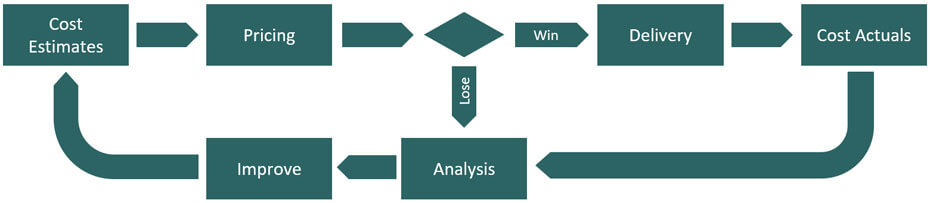
Projects of a significant size tend to follow the same basic structure across sectors such as construction, engineering and manufacturing. Terminology varies, but in the most basic form the steps are: costing, pricing, decision (win/lose) and delivery with actual costs.

Some projects can be highly complex of course, incorporating lots of moving parts and interdependency. One small failure can quickly snowball. This may be common, but to accept it as the norm is a failure to embrace improvement. A business must build a mechanism to learn from individual failures to improve as an organisation.
“You must learn from the mistakes of others. You can’t possibly live long enough to make them all yourself.” Samuel Levenson
At the top level, a project has six outcomes in this context which may be described on two axes. The vertical won/lost axis and the costing axis which is original estimated costs versus the actual delivery cost.
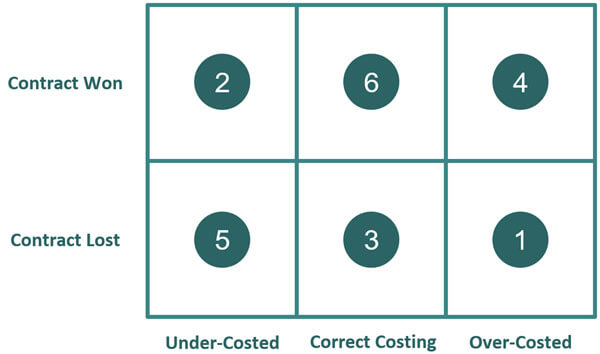
For the boxes along the bottom row, you will not know the actual cost of delivery as the contract was lost, so it is hypothetical. This makes it even more important to be confident that costings are accurate, as not knowing why contracts are lost are a big hurdle to improving competitiveness.
Consider each in turn:
“It’s much easier to double your business by doubling your conversion rate than by doubling your traffic.” Bryan Eisenberg
To get the proper visibility it is important to set up a solid cost structure. The main aim is to reduce the reliance on overhead codes and allocate direct costs properly. Ideally you need to book as much as you can to direct project codes to get a true reflection of project costs. For example, if all internally managed transport function is booked to an overhead code, the cost is skewed as overheads are distributed by sales value (or similar) and not actual use. By booking the vehicle and its mileage to a project, then amortising the costs accordingly you will get a more accurate picture of the project costs.
There may be a concern that this adds to workload. In the short-term it will a little. But as more projects are handled this way you will be able to create templates from successful project elements, which form the building blocks for future projects.
The granular data structure means the data can be used as an improvement tool. Where there is deviation between estimate and actual costs, you can drill down into the data to find out why. You can also compare projects at different levels to gain insight and true business intelligence.
By closing the costing loop, improvement cycles are created, and this will improve competitiveness as costing processes become more refined. But there is more…
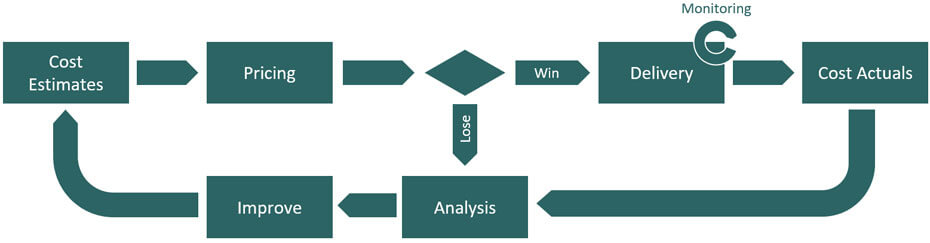
Collecting the data at the end of a project allows the closure of the loop for the whole project, but there is great advantage to collecting the cost data as the project is running. Live (or near to) data collection. Ideally the data should be collated in a centralised database (in the cloud if your teams are mobile) because this presents a fantastic opportunity.
Rather than just reviewing on project completion, project performance can be monitored continually. A loop within a loop. To achieve this there is one element missing.
Take an example. Say one element of a project is estimated to cost £100,000 (labour, materials, asset use, etc) and should take 6 weeks. You are three weeks in, and you have spent £50,000. Superficially it looks like it is on track. But progress may not be in line with spend and time. Only when you capture ‘earned value’ will you know. If this project element has earned value of 25%, then you are 100% over-spent and 1.5 weeks behind. Good to know sooner rather than later, as a snowball effect could impact the whole project and early detection will give a greater chance of recovery.
Earned value is quite simple and common. The trick is to break it down to suitable elements. Break it down too far and it becomes onerous to manage, not far enough and you do not get the intelligence value.
If the work breakdown structure (WBS) is linked to costs and earned value, further benefit can be derived. Add payment stages and supplier terms and you can create a cashflow forecast.
The open-loop process from above is now developed into a closed-loop improvement driven process. This process will improve cost accuracy, protect margins and support growth.
The benefits of closed loop project management can be enormous. But how would you go about it? Every business is different of course, but here are the main steps:
“An organization’s ability to learn, and translate that learning into action rapidly, is the ultimate competitive advantage.” Jack Welch
Whilst building a process like this, it is easy to get bogged down in too much detail. My top tip for this: Design the framework first, to ensure anything you do does not preclude future developments. Then build simple versions of the process within the framework allowing you to add detail and refinements later. In other words – start simple.
A brief note on reporting. You can categorise reporting into two camps; one is the repetitive reports that you need to see on a regular basis. They tend to be the same and are there to highlight exceptions, e.g. KPIs, status reports etc. These can be automated.
The other type of report is those used to solve problems. They tend to be more flexible. They are an exploration of the data to understand cause and potential solutions to problems. You cannot really automate these in the same way, but it is important to base them on a single version of the truth. This is where Excel and Power BI are their most useful.
Closing the loop on project delivery will drive improvement and competitive advantage but it is a tough journey.
“The most valuable commodity I know of is information.” Gordon Gekko